Marine Vapor Recovery & Barge Degassing Services in Dallas
Who Handles USCG-Certified Marine Vapor Recovery at Dallas-Area Terminals?
Marine loading operations at Dallas-area terminals require vapor control systems that meet federal certification standards before a single product transfer begins. Envent has been deploying portable, USCG-certified vapor recovery systems to marine facilities across North America since 1992, covering everything from barge degassing to full loading cycle vapor control.
All systems operate under 33 CFR 154 Subpart P and 46 CFR 39, the federal standards that govern vapor control design, operation, and certification on tank vessels during marine loading. Every deployment is staffed by OQ-qualified technicians and runs to full EPA compliance requirements.
The onsite team was proactive, kept us updated, and never left us wondering. We’ve already requested them for our next tank project.
Tank Maintenance Manager, Major Midstream Operator
It’s always a pleasure to work with your team. From degassing through refloating the internal roof, the planning and field execution were outstanding. The crew got set up fast, and the technicians are always kind, polite, and deliver an amazing service. We look forward to our next project with you.
Tank Maintenance Team, Canadian Refinery
They provided timely communication and, with the support of their teams, contributed to a safe Turnaround. Their quick response to events helped us maintain our commitments to safety and the environment. I would not hesitate to recommend them to lead crews on other jobs.
Area Technical Manager at Irving Oil
They deliver exceptional performance, over and beyond our expectations contractually.
S&H Superintendent at BP
Based on this experience, I am comfortable recommending Envent Corporation for any degassing, vapor control, or related services. Their technical capability and consistent performance make them a dependable service provider.
Senior Project Engineer, Valero Houston Refinery
Envent Corporation completed their scope ahead of schedule and under budget. Their planning, resource management, and execution met the needs of the project.
Senior Project Engineer, Valero Houston Refinery
Safety remained a consistent focus during the project. Envent Corporation’s approach to identifying and addressing potential risks contributed to a safe work environment for personnel.
Senior Project Engineer, Valero Houston Refinery
Envent Corporation mobilized promptly and reached the required degas threshold within 18 hours of startup, prior to any tank washing or cleaning.
Senior Project Engineer, Valero Houston Refinery
Envent Corporation demonstrated professionalism and provided reliable engineering and operational support throughout the job.
Senior Project Engineer, Valero Houston Refinery
Why Do Marine Terminals in Dallas Need Emission Control on Every Loading Operation?
The Clean Air Act requires VOC emission control on marine loading operations, and that covers every product transfer at your dock. Marine Vapor Recovery systems must meet both USCG and EPA standards to keep your terminal within permit limits.
A portable vapor recovery system handles that without the cost or construction timeline of a fixed installation. Your loading operation stays on schedule, your permit stays intact, and nearby communities and waterways stay protected.
What Makes Barge & Marine Vessel Degassing Different from Land-Based Operations?
Marine vapor control at Dallas-area terminals carries regulatory obligations that go beyond a standard tank degassing project. Your operation has to meet both Clean Air Act emission control requirements and USCG safety standards at the same time, and those two sets of rules have to be managed together on the water.

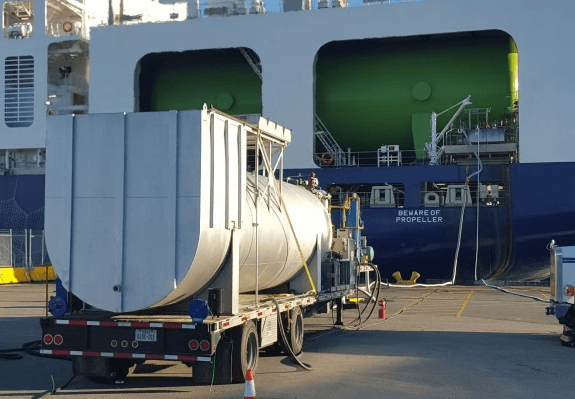

How Does Envent Handle Barge & Marine Vessel Degassing?
Barge and ship degassing involves vapor concentrations, confined spaces, and waterside access conditions that land-based tank work does not. Envent’s field teams are trained specifically for marine environments and hold the USCG certifications required to operate vapor control systems during active loading and degassing at your dock.
All vapor control work meets the requirements under 33 CFR 154 Subpart P for vapor control and destruction during marine operations. Envent has run these projects at ports and terminals across North America, and that field experience carries directly into how your Dallas operation is managed.
What Regulatory Standards Apply to Marine Vapor Recovery at Your Dallas Terminal?

The Clean Air Act requires VOC emission control from marine loading operations, and terminals must meet both USCG and EPA standards to stay in compliance. Two federal regulations govern this work directly:
- 33 CFR Part 154 Subpart P: USCG rules covering the design, operation, and certification of vapor control systems used during marine loading.
- 40 CFR Parts 61 and 63: EPA standards for hazardous air pollutants and VOC emission control at marine terminals.
Envent operates to both sets of requirements on every marine project in Dallas and across North America. Your terminal stays within permit limits and your loading operation runs without regulatory exposure. Envent’s compliance standards and project documentation are available for review before any marine operation begins.
Featured Case Study
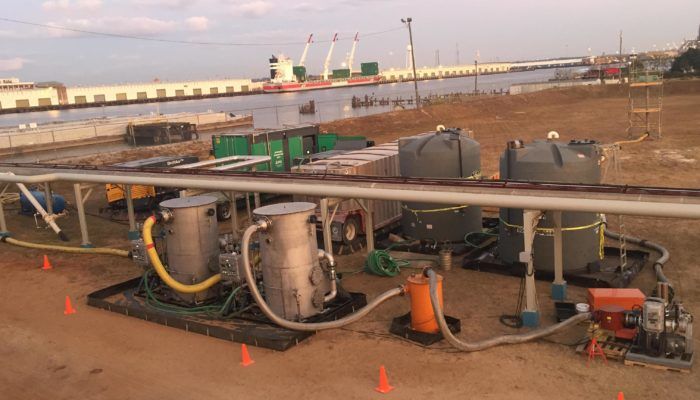
The Problem: A refinery needed pipeline maintenance without stopping barge shipments. A full shutdown would have cost over $3M and put the facility out of compliance with USCG 33 CFR 154 emission standards.
What We Did: A temporary Marine Vapor Control System was deployed to the site. Vapor flow during active loading was managed throughout the full maintenance period, keeping barge shipments running without interruption while the pipeline was out of service.
The Result: The refinery avoided the $3M loss, stayed within full regulatory compliance, and completed the project with zero safety incidents. Destruction efficiency held at 99.9% throughout the operation.
Why Do Dallas Terminals Choose Mobile Marine Vapor Control Over Fixed Installations?
Marine vapor control at your Dallas terminal does not require permanent infrastructure or capital construction. We have been deploying mobile vapor recovery systems to ports and terminals across North America since 1992, and our field engineers manage the work from arrival through completion.
Every operation we run meets USCG standards under 33 CFR 154 Subpart P and EPA BACT requirements for vapor destruction at marine facilities.
What Does Your Terminal Avoid When You Work With Us?
| What You Avoid | What We Handle |
|---|---|
| Capital expenditure on permanent infrastructure | We deploy mobile systems directly to your dock |
| Engineering overhead and project management | Our field engineers manage setup and operation on-site |
| Construction permitting delays | Our mobile equipment bypasses building permit requirements |
| Air permit complexity | We manage the air permit process for your project |
| HAZOP preparation time | We review and verify safety protocols before field work begins |
| USCG certification gaps | Our systems arrive pre-certified to 33 CFR 154 Subpart P |
How Do We Manage Vapor Control Safety at the Dock and on the Vessel?

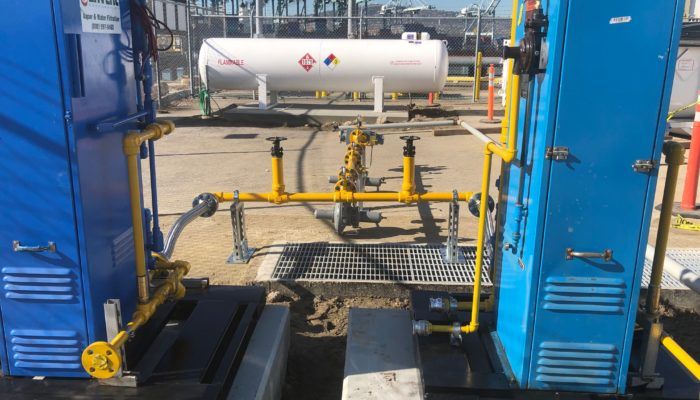
Vapor control at a marine terminal involves two separate points where vapors need to be managed, at the dock connection and at the destruction unit. Our teams set up and operate both elements under a single deployment, with all safety protocols in place before loading begins.
Every system we bring to your Dallas terminal is fully USCG certified and operates above the minimum EPA-mandated combustion temperature for complete hydrocarbon vapor destruction. Vapor concentrations are kept outside the explosive range throughout the loading cycle, and the setup meets EPA BACT standards for marine vapor control operations.
Our field engineers handle the full dock-side setup, vessel connection, and operation for both short-term loading runs and longer-term marine vapor control projects. You get a single certified system, managed by one crew, with all compliance documentation handled on our end.
Featured Case Study

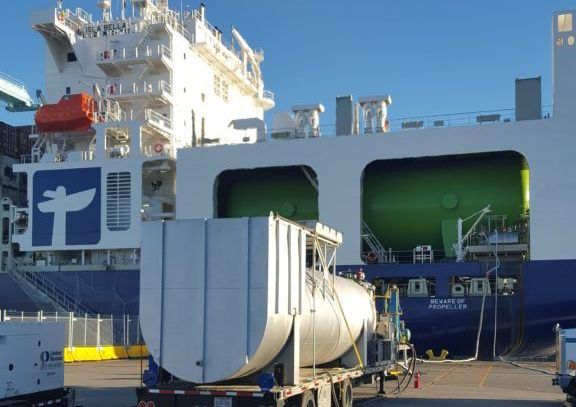
The Problem: A U.S. built LNG fueled container ship needed valve repairs on its twin Type-C cryogenic fuel tanks. Each 1,200 cubic meter tank had to be degassed of methane vapors and inerted with nitrogen while the vessel stayed on its commercial schedule. Full USCG 33 CFR 127, 46 CFR 154, and Class NK compliance was required with zero schedule flexibility.
What We Did: Envent deployed a first of its kind mobile system using a hot nitrogen splice in to keep carbon steel components safely above the brittle fracture range. A 42 MMBTU per hour enclosed thermal oxidizer ran at 99.9% methane destruction efficiency, verified by USCG and Class NK. Daily coordination was maintained with the USCG Captain of the Port, the Fire Marshal, and the Ship Master throughout.
The Result: The project ran 24 hours a day for two months with zero incidents, zero delays, and zero LEL excursions. The vessel sailed on schedule without interruption. This was the first U.S. deployment of a 42 MMBTU mobile thermal oxidizer for cryogenic marine LNG degassing under full USCG oversight. The USCG Captain of the Port and Ship Master both described the execution as flawless.
Want to See How We Handle Marine Vapor Recovery & Barge Degassing in the Field?

Marine Vapor Recovery & Barge Degassing in Dallas FAQs
What regulations does my Dallas terminal need to meet for marine vapor recovery?
Your terminal must meet USCG requirements under 33 CFR 154 Subpart P for vapor control during marine loading, along with EPA standards under 40 CFR Parts 61 and 63 for VOC and hazardous air pollutant control. Both apply to every product transfer at your dock regardless of product type or vessel size. Our team arrives with systems pre-certified to both sets of requirements. Our compliance documentation is available before any work begins.
Does Envent work at marine terminals and docks in the Dallas–Fort Worth area?
Yes. We deploy to terminals, industrial docks, and inland marine facilities across North Texas including Dallas and Fort Worth. Our field teams mobilize from regional staging points and arrive with the vapor recovery equipment your operation requires. Call 888-997-9465 to talk through your site location and timing, or request a quote online.
My barge needs degassing before a product change. Can Envent handle that?
Yes. We remove residual hydrocarbon vapors from cargo tanks to levels that meet OSHA confined space standards under 29 CFR 1910.146 and your port safety requirements. Your vessel is ready for entry or nearby ignition sources when we are finished. We have handled this type of work at terminals across Texas, including unplanned callouts where the schedule moved faster than expected. Call 888-997-9465 to discuss your vessel and timeline with our degassing team.
How does Envent control VOC and H2S emissions during marine loading?
We use thermal oxidation to capture and destroy VOCs and H2S produced during loading. Our systems run at 99.9% destruction efficiency, meeting EPA BACT standards for vapor control at marine facilities. Vapor concentrations are kept outside the explosive range throughout the loading cycle. Our field team provides full emissions records and project documentation at the close of every operation.
What if my vessel arrives outside of scheduled hours and needs emergency degassing?
Call 888-997-9465. We operate 24/7 for emergency vapor control deployments across North Texas. If a vessel arrives unplanned or a degassing situation comes up outside normal hours, our field team mobilizes with the equipment your project requires. Call us when the situation comes up and we will sort out the logistics from there. Our teams have responded to emergency marine degassing situations at terminals across Texas and Louisiana on short notice.
Does my terminal need an air permit for marine vapor recovery operations?
Yes. Marine loading operations that generate VOC emissions above threshold levels require air permits under Texas Commission on Environmental Quality rules and federal EPA standards. We manage the air permit process as part of the project so your terminal stays within permit limits throughout the operation. If your permit status is unclear, our engineering team can walk through the requirements with you.
Are your technicians qualified to work on an active dock and in confined spaces?
Yes. Every technician we send to your site is OQ-qualified and trained to OSHA 29 CFR 1910.146 confined space entry standards. For marine work, the team also follows USCG operational protocols and any port-specific safety requirements at your facility. Our safety record stands at 0.0 TRIR across all field operations. That number covers every project we have run since 1992.
Why would my terminal use mobile vapor recovery instead of building a fixed system?
A mobile deployment meets the same USCG and EPA BACT requirements as a permanent installation without the capital cost, construction timeline, or building permit process. There is no infrastructure to design, permit, or maintain after the project is complete. Our field engineers handle setup, operation, and all compliance documentation. When loading schedules are tight, a mobile deployment removes the wait time that comes with permanent construction. Our marine vapor recovery page has more detail on how we run these projects.
What types of vessels and products has Envent worked with?
Does Envent cover other Texas locations if we have terminals outside of Dallas?
Yes. We operate across the full state of Texas including the Texas Gulf Coast, Houston, Port Arthur, Corpus Christi, and Beaumont. We also cover Louisiana, California, and terminals across the United States and Canada. If your terminals are spread across multiple states, one call to 888-997-9465 covers the conversation.
Ready to Talk Through Your Marine Vapor Control Project in Dallas?
Every marine loading operation at your Dallas terminal has a compliance deadline. Our field engineers have been meeting those deadlines since 1992, and every project we run is fully managed under USCG and EPA requirements with all permitting handled on our end.
Call 888-997-9465 or request a quote below to talk through your site, schedule, and project scope.
Or
