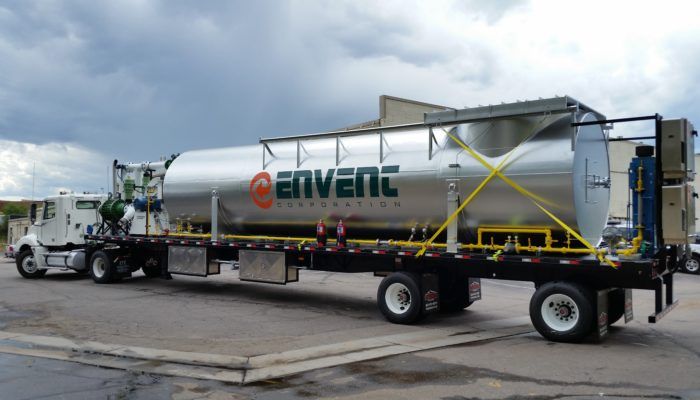
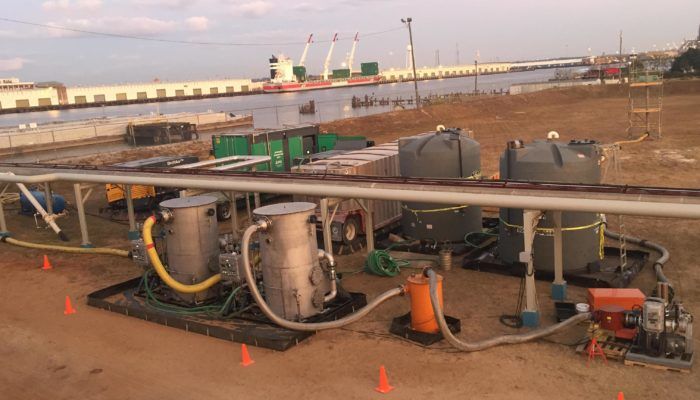
When your facility needs to control benzene, VOCs, or H2S during a tank cleaning, turnaround, or product transfer, your permit conditions set the bar. Our mobile carbon scrubbing systems are built to meet EPA BACT requirements and Benzene NESHAPS standards. Every deployment is HAZOP and MOC reviewed before the system starts, so the setup your crew receives on site is already checked against your permit limits.
We run carbon scrubbing across refineries, petrochemical plants, and chemical terminals throughout North America. If your site needs VOC abatement on a tank, loading rack, or transfer point, our scrubbers and odor control crews have worked the same type of job under the same regulatory conditions before.
The onsite team was proactive, kept us updated, and never left us wondering. We’ve already requested them for our next tank project.
It’s always a pleasure to work with your team. From degassing through refloating the internal roof, the planning and field execution were outstanding. The crew got set up fast, and the technicians are always kind, polite, and deliver an amazing service. We look forward to our next project with you.
They provided timely communication and, with the support of their teams, contributed to a safe Turnaround. Their quick response to events helped us maintain our commitments to safety and the environment. I would not hesitate to recommend them to lead crews on other jobs.
They deliver exceptional performance, over and beyond our expectations contractually.
Based on this experience, I am comfortable recommending Envent Corporation for any degassing, vapor control, or related services. Their technical capability and consistent performance make them a dependable service provider.
Envent Corporation completed their scope ahead of schedule and under budget. Their planning, resource management, and execution met the needs of the project.
Safety remained a consistent focus during the project. Envent Corporation’s approach to identifying and addressing potential risks contributed to a safe work environment for personnel.
Envent Corporation mobilized promptly and reached the required degas threshold within 18 hours of startup, prior to any tank washing or cleaning.
Envent Corporation demonstrated professionalism and provided reliable engineering and operational support throughout the job.
Choosing the right carbon media starts with your process conditions, not a default selection. We review your contaminant profile, flow rate, and permit limits before the system is built, so the media performs through the full job without early breakthrough.
Vapor Phase GAC
Granular activated carbon for air emission control on tanks, loading racks, and industrial vent streams, selected based on contact time and your specific compound profile. See our degassing and vapor control page for more.
Liquid Phase GAC
Carbon media for contaminated process water, sized to your flow rate and contaminants present. Our mobile water treatment crews manage media exchange and carbon disposal on site.
Specialty Impregnated Carbon
When standard carbon cannot meet your permit limits, we use caustic or potassium permanganate impregnated carbon for elevated H2S or ammonia under TCEQ permit conditions.
We run a mobile fleet of trailer-mounted carbon scrubbers and liquid scrubbers for vapor phase and odor control across refineries, chemical terminals, and industrial sites. Our systems are permitted by regulatory agencies including South Coast AQMD and meet EPA requirements for VOC abatement. Our crews are available for planned deployments and scheduled carbon change-outs on mobile or stationary systems at your facility.
Vacuum Truck Vapor and Odor Control: We manage emissions during loading and unloading operations at terminals and product transfer points. Vapor capture during product movement is a permit requirement on most active terminal sites. See how we handle loading rack vapor control on our degassing and vapor control page.
High-Volume Vapor Control: We deploy scrubbing systems for sites generating large vapor volumes during tank cleaning or purging. Refinery and midstream facilities with multiple active vapor sources running at the same time are the most common fit for this service.
Industrial Carbon Filters: We deploy carbon filter units for vessel and pipeline purging where vapor concentrations need to drop before a confined space entry or hot work permit can be issued. Media is selected based on the compounds present and your safety team’s concentration limits. Our tank and vessel degassing crews include this in the standard pre-entry scope.
Post-Treatment Cleanup: We add a polishing step after the primary treatment unit for liquid and chemical scrubbing of sour gas streams carrying NH3 and H2S. This keeps the treated stream within permit limits when inlet concentrations are variable or higher than a single-pass system can handle on its own.
MSS Certified Units: We deploy trailer and skid-mounted units built for refinery turnaround compliance. These units meet the permit and inspection requirements that your turnaround team is working against. Visit our refinery turnaround vapor control page for more on how we support planned outages.
Vapor Scrubbers: Our mobile vapor scrubbers handle VOC and H2S streams at refineries, petrochemical plants, and chemical terminals. For a full picture of what our scrubbing service covers, visit our scrubbers and odor control page.
Municipal and Commercial: We deploy mobile carbon scrubbers to capture odor-causing compounds at the source for municipal wastewater sites, landfills, and commercial facilities dealing with community or regulator odor complaints.
We work with vapor-phase activated carbon to remove organic contaminants from hazardous vapor streams at refineries, chemical terminals, and industrial sites. Media selection is based on the molecular weight and concentration of the contaminants in your stream, whether that calls for coal-based, coconut shell, or impregnated GAC, and carbon bed sizing is confirmed against your inlet concentration, flow rate, and permit limits before the system ships.
Product Data Sheets:
4×8 Coal Based (ECARB 48)
4×10 Coal Based Carbon (ECARB 410)
4×8 Coconut Shell Based (ECOC 48)
4×10 Coconut Shell (ECOC 410)
We have designed, permitted, and operated liquid phase carbon scrubbing systems to remove contaminants from water streams on industrial and environmental projects across North America. Our systems are built to meet NPDES discharge requirements for industrial facilities, and we review every deployment against your site’s permit conditions before the system goes on line.
Hydrotest Water Treatment: We handle high-flow filtration for pipeline and storage tank hydrotest programs, removing corrosion inhibitors and oxygen scavengers from the water stream so discharge meets your permit conditions. For more on how we support pipeline and tank work, visit our water treatment page.
Vessel Hydrotest Management: We manage the treatment and disposal of contaminated water from reactors, columns, and pressure vessels during turnaround and maintenance scopes. We work within your turnaround timeline to keep vessel water volumes on schedule.
Contaminated Oily Water: We run oil-water separation and carbon scrubbing on refinery and oil field sites where runoff or process water carries TPH and benzene above discharge limits. Our refinery market page covers more of the work we do in this space.
Groundwater Treatment: For remediation sites with VOC and chlorinated solvent contamination in site groundwater, we run carbon adsorption and air stripping systems as part of the treatment scope. Visit our soil vapor extraction page.
Industrial Wastewater: We deploy liquid phase carbon systems on industrial wastewater streams where dissolved organics, solvents, or regulated compounds need to be removed before the water can be discharged or reused. This applies to chemical plants, terminals, and manufacturing facilities handling regulated process water.
We work with liquid phase carbon to remove organic and inorganic contaminants from wastewater, groundwater, and process water on industrial, municipal, and commercial sites. Media selection is based on the molecular size of the pollutants and flow velocity, whether that calls for coal-based carbon, coconut shell carbon, specialty clays, or zeolite for emulsified oil and grease capture. Visit our water treatment page for more on contaminated water stream treatment.
Product Data Sheets:
8×30 Coal Based (EWCARB 830)
8×30 Coconut Based (EWCOC830)
12×40 Coal Based (EWCARB1240)
12×40 Coconut Based (EWCOC1240)
We run a mobile fleet of trailer-mounted carbon scrubbers and liquid scrubbers for vapor phase and odor control across refineries, chemical terminals, and industrial sites. Our systems are permitted by regulatory agencies including South Coast AQMD and carry vapor phase granular activated carbon media based on coal or coconut shell to match your vapor stream requirements.
We maintain the largest mobile fleet of odor control units in North America, available for emergency response on pipeline blowdowns, sewers, digesters, storage tanks, vacuum trucks, and high-flow air mover applications. Our crews handle on-site media exchange and carbon disposal as part of the deployment scope. For more on how we support vapor control operations, visit our scrubbers and odor control page.
The Problem: A Texas City refinery running active sulfur loading operations needed vapor control on H2S streams generated during the loading sequence. The permit conditions required the vapor stream to be treated before any release, and the loading operation could not stop once the job was underway to swap out media or reconfigure the treatment setup.
What We Did: We deployed a mobile scrubbing system sized for the H2S concentrations present on site and ran it through the full loading sequence. Our OQ-qualified crew managed the system on site and coordinated with the facility’s safety team on confined space and hot work requirements throughout the job.
The Result: The system ran without a permit exceedance from start to finish. The refinery kept its loading schedule on track without stopping operations to deal with vapor control issues during the job.
See how our crews have handled vapor scrubbing and odor control across refineries, terminals, and industrial sites throughout North America.
Activated carbon scrubbing pulls contaminated vapor through a bed of granular activated carbon, where VOCs, H2S, benzene, and other organic compounds adsorb onto the carbon surface and are held there until the media is spent and replaced. The process works on both vapor phase and liquid phase streams, depending on whether your site is dealing with air emissions or contaminated process water. We size the carbon bed to your specific contaminant profile and flow rate so the system performs through the full job without early breakthrough. For more on how we approach vapor control at the source, visit our degassing and vapor control page. EPA guidance on VOC control methods is available at the EPA air pollutant emissions trends page.
Yes. All of our carbon scrubbing deployments in Texas are sized and operated to meet the emission limits in your facility’s TCEQ permit. We work with your environmental team before the system starts to confirm the design meets your permit conditions, including VOC and H2S control requirements on storage tanks, loading racks, and process vessels. TCEQ enforces specific air quality rules for industrial facilities operating in the Dallas area, and our systems are built to comply with those standards. Current TCEQ air quality guidance for Dallas industrial facilities is available on the Texas Commission on Environmental Quality website. For more on our compliance record, visit our compliance page.
Vapor phase carbon scrubbing treats air emission streams, pulling VOCs, H2S, benzene, and hazardous air pollutants out of a gas stream before it is released to the atmosphere. Liquid phase carbon scrubbing treats contaminated water streams, removing dissolved organics, chlorine, and trace hydrocarbons from process water, groundwater, or wastewater before discharge. The two approaches use different carbon media selected for the molecular weight and concentration of the contaminants in each stream. Many of our Dallas-area projects involve both vapor and liquid phase treatment running at the same time on the same site. Visit our water treatment page for more on how we handle liquid phase carbon on active industrial sites.
Carbon scrubbing works best for lower-concentration vapor streams, sites where open flame or combustion is not permitted, and jobs where a compact, passive treatment system fits the site layout better than a thermal unit. A thermal oxidizer is better suited for high-volume or high-concentration streams where combustion is permitted and a destruction efficiency 99.9% is required by your permit. We carry both mobile carbon scrubbers and thermal oxidizers and can recommend the right approach based on your vapor load, permit conditions, and site constraints. For more details on thermal oxidation, visit our thermal oxidizer services page. EPA guidance on Best Available Control Technology is available on the EPA BACT procedure page.
Every system we deploy meets EPA BACT standards, and our operations are built to comply with applicable MACT rules for the source category your facility falls under. We document system performance through field monitoring and provide records directly to your environmental team for permit reporting. For background on EPA BACT requirements and how they apply to your facility, visit the EPA Best Available Control Technology page. For more on how we approach regulatory compliance across all our services, visit our compliance page.
Our technicians are OQ-qualified and trained under OSHA 29 CFR 1910.146 confined space entry rules. We work within your facility’s hot work permit system and coordinate with your safety team on entry procedures before any work begins. Our field crews carry the personal protective equipment required for the specific vapor concentrations and confined space conditions present on your site. Our safety record holds at 0.0 TRIR across all field operations, and every deployment is HAZOP and MOC reviewed before the system starts. For more on how we approach safety across all our services, visit our safety page.
Yes. Some of the carbon scrubbing calls we receive in Texas come from facilities dealing with odor complaints from neighboring communities or regulators rather than from planned turnarounds or maintenance scopes. We deploy mobile scrubbing systems to capture the odor-causing compounds at the source and bring the site back within its permit limits. For municipal wastewater sites, landfills, and commercial facilities dealing with community or regulator complaints, our scrubbers and odor control crews handle the full deployment scope. TCEQ odor complaint and enforcement guidance is available on the Texas Commission on Environmental Quality website.
Send us your contaminant profile, flow rate, and permit limits and we will tell you what equipment makes sense for your site and what the deployment looks like. For planned turnarounds and maintenance scopes, we scope and schedule in advance to make sure the right system and crew are on site when your scheduled scope begins. For unplanned shutdowns or emergency vapor control situations, call our line at 888-997-9465 directly. You can also submit your project details through our request a quote page and our engineering team will follow up with you. For a look at how we have handled similar projects across Texas, visit our project library.
If your facility has a tank cleaning, turnaround, or vapor control situation coming up, send us your contaminant profile and permit conditions and we will tell you what fits. Our crews have been running carbon scrubbing on Texas industrial sites since 1992 and know what your permit requires.
Hi, I’m Steve Sellinger, CEO of Envent Corporation. We make it our policy at Envent
Corporation to listen to our customers so that we can improve our services, our processes and our products. Please use the form below to e-mail your comments, suggestions or questions to me.
Thank you for taking advantage of this opportunity to tell us how we can make your experience the best that it can be.
If you would like to submit feedback anonymously, please use the “Contact Us” link available here.